Profile
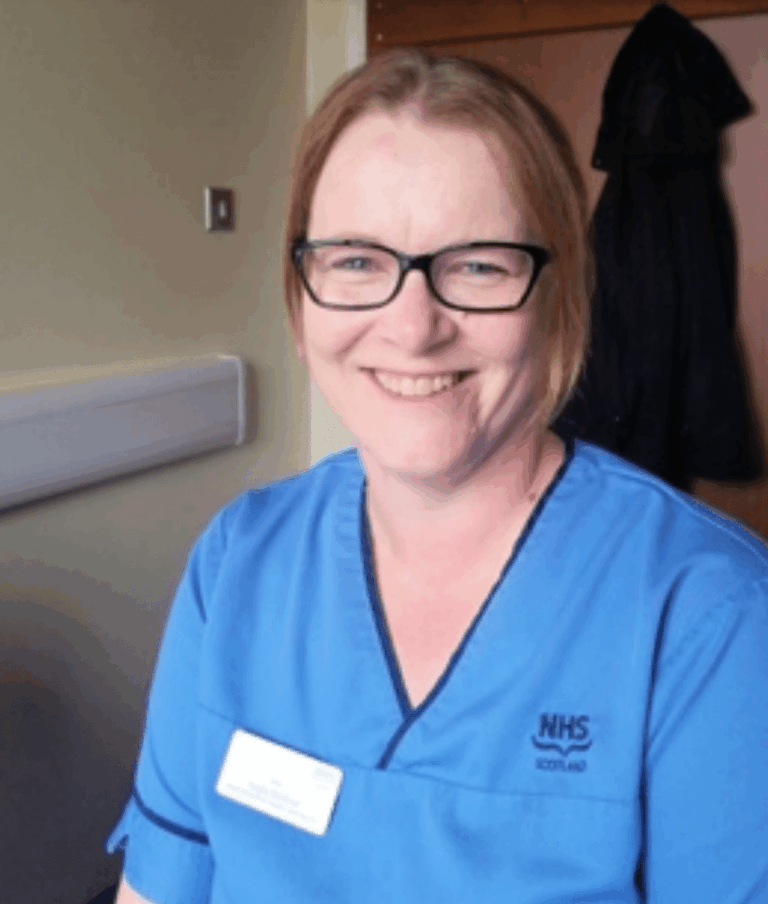
Ms Angie Balfour (UK)
Nurses Section ChairWestern General Hospital, Scotland, United Kingdom, United Kingdom

Working with an ERAS program is a multidisciplinary challenge to improve the standard of care. It requires extensive knowledge of the research evidence and care principles, as well as the organisational changes required to make ERAS programs function in clinical practice. The purpose of this Nursing and…

Working with an ERAS program is a multidisciplinary challenge to improve the standard of care. It requires extensive knowledge of the research evidence and care principles, as well as the organisational changes required to make ERAS programs function in clinical practice.
The purpose of this Nursing and Allied Health Professional Group is to have an International “bank of knowledge” for Nurses and Allied Health Professionals interested in ERAS, and to create a network for inspiration and knowledge sharing.
Knowledge sharing will take place at this website, where there will be:
Establishment of care-plans and pathways is a method to standardize surgical care and to plan nursing care with daily goals.
These care plans result in a nursing care more structured and focused than working with conventional care. Care plans are a working tool for nurses and describe in detail what to do, what the observations are, nursing duties and goals for oral intake, hours out of bed, and planned day of discharge and nutrition. Furthermore, the care plan provides documentation of nursing care and helps to eliminate undesirable variations in postoperative care. In this section, you will find below examples of selected care plans.
Nursing care program – Colonic resection Hvidovre Hospital, Copenhagen
Enhanced Recovery Programme St Mark’s Hospital
Do we miss a good example of a care plan?
Please contact us with any other examples that you would like us to publish in this section.
The booklets are developed by the McGill University Health Centre Surgery Recovery Program and modified by the ERAS Society Nursing group to fit the ERAS Society guidelines of 2012/2013. We would like to recognize and thank the MUHC Patient Education Office for permission to use the booklets.
It is possible to make local additions / changes in the booklet to fit in names, addresses, telephone numbers etc and to add your own logo, but it will not be allowed to make changes that differ from ERAS guidelines.
For copyright reasons, any changes must be done by the MUHC Patient Education Office and the expenses have to be paid by the local hospital ordering the change.
If you want to make additions / changes to the existing booklet, please send an email to The ERAS Society Office Manager Kristina Wikander (kristina.wikander@erassociety.org) and she will establish contact with MUHC.
Enhanced recovery after surgery (ERAS): barriers and solutions for nurses. Angie Balfour, Jeanette Amery, Jennie Burch, Henriette Smid – NanningaAsia-Pacific Journal of Oncology Nursing. In…
Expert ReviewPatients as partners in Enhanced Recovery After Surgery: A qualitative patient-led study Gillis C, Gill M, Marlett N, MacKean G, GermAnn K, Gilmour L, Nelson…
Expert ReviewUnderstanding the benefits and implications of Enhanced Recovery After Surgery Balfour A (2019) Understanding the benefits and implications of Enhanced Recovery After Surgery. Nursing Standard. …
Expert ReviewImplementing Enhanced Recovery After Surgery (ERAS) Program on a Specialty Nursing Unit. Tezber et al. The Journal of Nursing Administration. 48(6):303–309, JUNE 2018 What is…
Expert ReviewThe nurse’s role in the implementation of an ERAS programme Brady KM, Keller DS, Delaney CP. Successful Implementation of an Enhanced Recovery Pathway: The Nurse's…
Western General Hospital, Scotland, United Kingdom, United Kingdom

Bournemouth University, U.K.